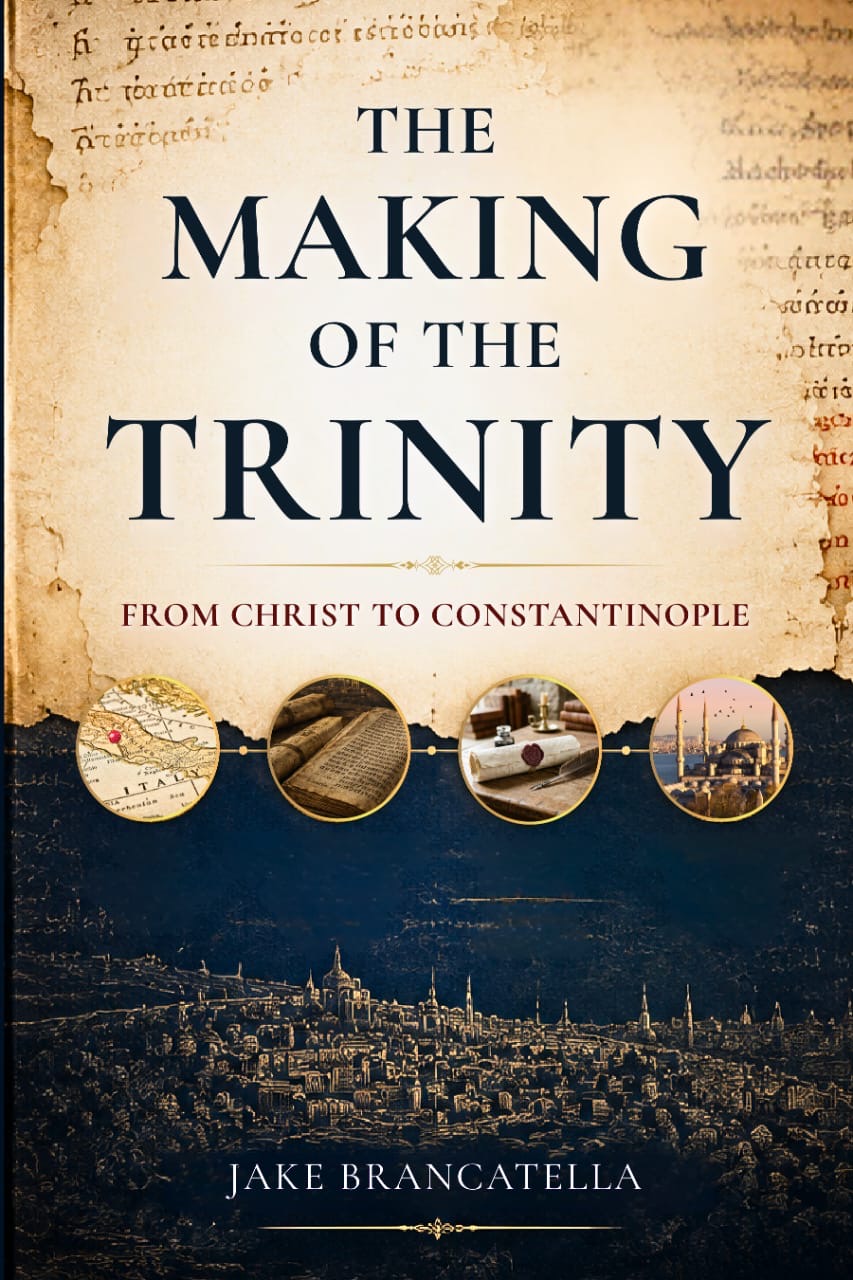
The Making of the Trinity
From Christ to Constantinople
Was the Trinity taught by Jesus — or a doctrine forged through centuries of fierce political and theological warfare?
Get notified.
Join the waitlist for presale access, signed-copy notifications, and early-reader perks.
Was the Trinity the original belief of the earliest Christians, or was it the result of centuries of theological development?
In The Making of the Trinity, Jake Brancatella examines the historical formation of Trinitarian doctrine from the New Testament period through the major debates of the early Church. Through close engagement with early Christian writings, patristic theology, and the controversies surrounding figures such as Justin Martyr, Irenaeus, Tertullian, Origen, Eusebius of Caesarea, and Athanasius, this book explores how Christian thinkers understood the Father, the Son, and the Holy Spirit before the doctrine was formally defined in later orthodoxy.
Rather than assuming later creeds as the starting point, this study asks what the earliest sources actually say. It investigates questions of divine hierarchy, Christ's relationship to the Father, the development of Logos theology, the role of the Holy Spirit, and the gradual emergence of Nicene and post-Nicene formulations.
The Making of the Trinity presents a carefully documented challenge to simplified narratives of doctrinal continuity. It argues that the doctrine of the Trinity did not appear fully formed at the beginning of Christianity, but developed through centuries of debate, reinterpretation, and controversy.
Accessible yet rigorous, this book is written for readers interested in early Christianity, Church history, patristic studies, Islamic-Christian dialogue, and the historical development of doctrine.
Inside the book.
- —
Introduction — Framing Our Inquiry
This section establishes the central question of the book: whether the doctrine of the Trinity was clearly taught by Jesus, the Bible, and the earliest Christian witnesses, or whether it emerged gradually through later theological development. It defines the criteria for Nicene Trinitarianism and explains why the writings of the early Church Fathers are crucial evidence for evaluating claims of historical continuity.
- I
Misreading Judaism: Philo and “Two Powers” in Heaven Theology
This section challenges the claim that pre-Christian Jewish theology already contained something substantially equivalent to the Trinity. By examining Philo of Alexandria and Jewish “two powers” discussions, it argues that Jewish intermediary figures and Logos concepts should not be anachronistically read as Nicene or proto-Trinitarian theology.
- II
The Apostolic Fathers and Early Post-Apostolic Witnesses
This section examines the earliest Christian writings outside the New Testament to determine whether the first post-apostolic generations taught anything resembling Nicene Trinitarianism. The evidence shows reverence for Christ, liturgical devotion, and developing Christological language, but not a fully formed doctrine of three coequal, coeternal divine persons sharing one essence.
- III
The Age of the Apologists: The Logos, Christian Monotheism, and Pagan Criticism
This section analyzes second-century Christian apologists who defended Christianity against Jewish and pagan criticism by using Logos theology. It argues that while these writers often called the Son “God” or “Logos,” they generally understood him as subordinate to the Father rather than as fully equal to the one Most High God in the later Nicene sense.
- IV
From Apologetic Explanation to Systematic Theology
This section traces the movement from occasional apologetic claims about Christ to more systematic theological reflection on the Father, Son, and Holy Spirit. Writers such as Tertullian, Hippolytus, Origen, Novatian, and Dionysius helped shape later Trinitarian vocabulary, yet their theology still contains subordinationist, developmental, or otherwise non-Nicene elements.
- V
The Late Pre-Nicene Period and the Road to Nicaea
This section examines the final stage before Nicaea, showing that major Christian thinkers still lacked a settled Nicene doctrine of the Trinity. The controversies involving Arius, Alexander, Athanasius, and Eusebius reveal that the early fourth century was not a simple defense of an already universally recognized Trinity, but a period of intense doctrinal conflict and clarification.
- VI
From Nicaea to Constantinople: Conflict, Clarification, and Conciliar Definition
This section argues that Nicaea did not immediately settle Christian doctrine, but instead initiated decades of controversy over the meaning of terms such as homoousios, hypostasis, and divine generation. The road from Nicaea in 325 to Constantinople in 381 demonstrates that Trinitarian orthodoxy was defined through prolonged debate, political conflict, regional councils, and theological refinement.
- —
Conclusion — From Early Diversity to Conciliar Definition
The conclusion restates the book’s central argument: the earliest Christian sources do not clearly teach Nicene Trinitarianism, but instead reveal a wide range of Christological and theological positions. The doctrine of the Trinity, as later defined by the councils, should therefore be understood as the result of historical development rather than as an explicit belief plainly taught from the beginning.